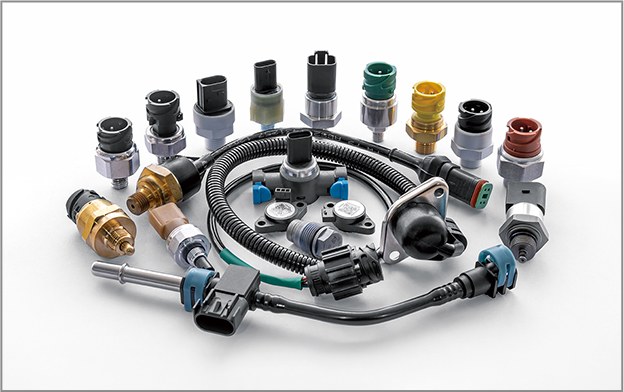
The application of automotive sensors is very extensive, such as:
1. The gasoline indicator is implemented through a liquid level sensor, which converts the high and low liquid levels into digital signals and can be easily read from the instrument panel
2. Water temperature sensor. The water temperature sensor is a temperature measuring node installed in the water tank. When the water temperature is too high or too low, it can also give an alarm or read directly from the display instrument.
3. In car air conditioning, which is controlled by a temperature sensor installed inside the car. The temperature sensor has a temperature setting that automatically starts when the temperature is too low, and automatically cools down when the temperature exceeds
4. Wiper sensor, wipers use sensors to sense the size of rainwater and control the frequency of the wipers. That is to say, when the rainwater is large, it blows faster, and when it is small, it blows slower.
5. The engine management system uses various sensors to convert the intake air volume, cooling water temperature, engine speed, acceleration and deceleration into electrical signals, which are then sent to the controller. The controller compares this information with stored information, calculates accurately, and outputs control signals. EMS can not only accurately control fuel supply to replace traditional carburetors, but also control ignition advance angle and idle air flow, greatly improving engine performance.
6. Control system principle: By installing a pedal sensor on the accelerator pedal, the pedal information is transmitted to the throttle control module in the electronic controller. The throttle control module calculates the opening of the throttle valve through a certain processing program and drives the DC motor to adjust the throttle intake passage area, thereby controlling the intake volume and meeting the intake requirements of the engine under different operating conditions.
7. Knock sensor function: detects the vibration of the engine cylinder block for the electronic controller to identify engine knock conditions. Principle: A detonation sensor is a type of vibration acceleration sensor. It is installed on the engine cylinder block and can hold one or more. The sensitive component of the sensor is a piezoelectric crystal. When the engine detonates, the engine vibration is transmitted to the crystal through the mass inside the sensor. Piezoelectric crystals generate voltage on their two poles due to the pressure generated by the vibration of the mass, converting the vibration into a voltage signal output.
8. Idle speed regulator function: Provides an idle bypass air channel and affects the bypass air volume by changing the channel cross-sectional area, achieving closed-loop control of engine speed during idle conditions.
Principle: A rotating slider is rigidly connected to a permanent magnet that can rotate freely on the shaft inside the idle speed regulator. The permanent magnet can rotate under the drive of the cable coil, causing the slider to rotate accordingly. The angular position of the slider determines the opening of the actuator's bypass airflow channel, allowing for the adjustment of the bypass airflow volume. The electronic controller determines the angular position of the slider by changing the duty cycle of the pulse signal transmitted to the actuator, thereby determining the bypass air flow rate.
9. Oxygen sensor function: Measure the oxygen content in the engine exhaust to determine whether gasoline and air are completely burned. The electronic controller implements closed-loop control with the goal of excess air coefficient λ=1 based on this information to ensure that the three-way catalytic converter has the maximum conversion efficiency for the three pollutants HC, CO, and NOX in the exhaust.
Principle: The sensing element of the oxygen sensor is a ceramic tube, with exhaust gas on the outside and atmosphere on the inside. Ceramic tube is a solid electrolyte that, after heating, relies on the catalyst on the outer wall of the ceramic tube to cause chemical reactions among various components in the exhaust gas, and oxygen ions can diffuse through the ceramic tube.
10. Throttle position sensor function: provides engine load information and operating condition information.
Principle: This sensor is actually a rotary potentiometer with linear output characteristics. The potentiometer arm is coaxially installed with the throttle valve. When the throttle valve rotates, it drives the potentiometer arm to slide to a certain resistance position, and the potentiometer outputs a voltage signal proportional to the throttle valve position.