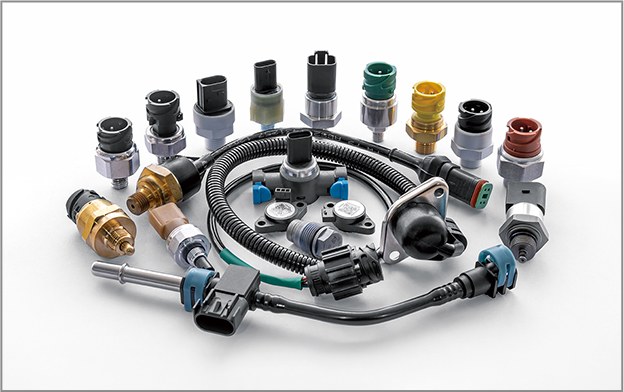
Sensors refer to devices or equipment that can sense specified physical quantities and convert them into usable input signals according to certain rules. Simply put, sensors are devices that convert non electricity into electricity.
Sensors usually consist of three parts: sensitive components, conversion components, and measurement circuits.
1) Sensitive components refer to the parts that can directly sense (or respond to) the measured object, that is, the sensitive components measured by the sensor are converted into non electric or other quantities that have a certain relationship with the measured object.
2) The conversion component converts the aforementioned non electric quantities into electrical parameters.
3) The function of a measurement circuit is to process and convert the electrical parameters input by the conversion element into measurable quantities such as voltage, current, or frequency for display, recording, control, and processing.
Static characteristic parameter indicators of sensors
Sensitivity
Sensitivity refers to the ratio between the output y and input x of a sensor in steady state, or the ratio between the increment of output y and the increment of input x, expressed as k=dY/dX
2. Resolution
The minimum amount of change that a sensor can detect within a specified measurement range is called resolution.
3. Measurement range and measuring range
The range between the lower and upper limits of the measured value within the allowable error limit is called the measurement range.
4. Linearity (non-linear error)
The maximum deviation between the sensor calibration curve and the fitted line under specified conditions, as a percentage of the full-scale output value, is called linearity or nonlinearity error.
5. Delay
Hysteresis refers to the degree of inconsistency between the forward and reverse stroke characteristics of a sensor under the same working conditions.
⒍ Repeatability
Repeatability refers to the inconsistency of the characteristic curve obtained by continuously changing the input quantity in the same direction multiple times within the entire measurement range under the same working conditions.
7. Zero drift and warm drift
When there is no input or when the input is another value, the maximum deviation of the input value from the original reading at regular intervals and the percentage of the full range are zero drift. And for every 1 ℃ increase in temperature, the maximum deviation of the sensor output value from the full range as a percentage is called temperature drift.